
Fostering Curiosity in Preschoolers: A Parent's Guide

What if the most powerful tool for your child's future isn't a tablet or a test score, but a simple question? We all want our little ones to thrive. It's natural to feel the pressure of the Singapore education system. Perhaps you worry that relying on screens or providing instant answers stifles their natural spark. Learning how to foster curiosity in preschoolers is about shifting from giving answers to co-designing experiments. It is about building a discovery muscle. A habit of wonder. A path to growth. This transformation starts at home, fueled by your encouragement and their innate desire to explore.
This guide provides science-backed strategies to ignite your child's curiosity and build a solid foundation for future success. We will explore actionable daily habits and the vital link between wonder and logic. You will also discover how specialized enrichment like Junior Engineer, Junior Programmer, or STEMtastic workshops turn play into a powerful learning journey. We are here to help you bridge the gap between passive screen time and active, hands-on discovery. Let's start this adventure together.
Table of Contents
Why Curiosity is the Superpower for Singaporean Preschoolers in 2026
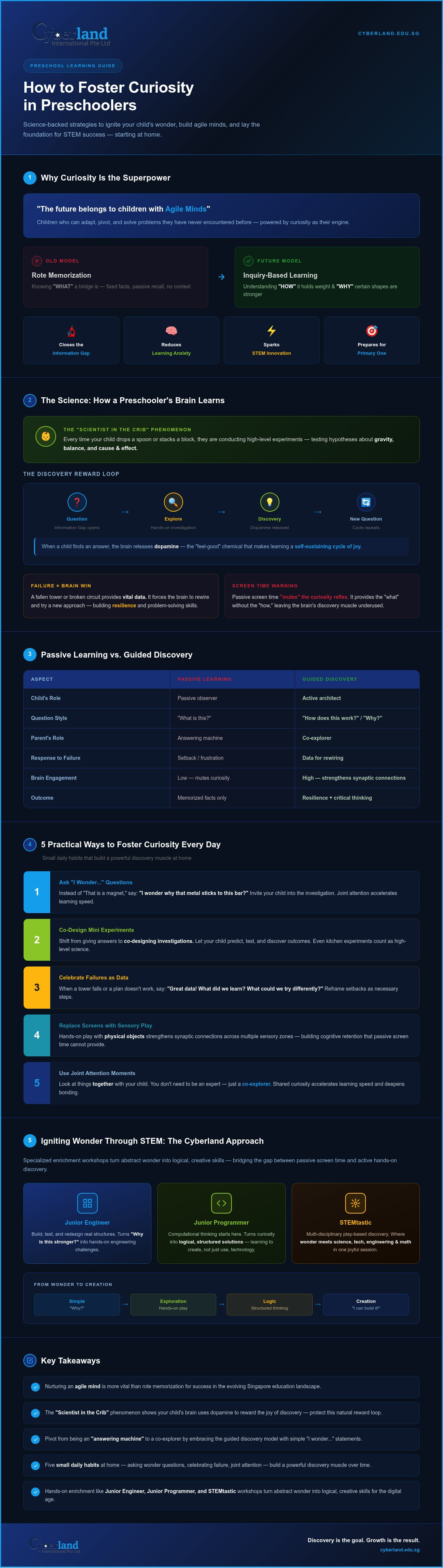
The world is changing at a breathtaking pace. By 2026, the skills our children need will look vastly different from the ones we practiced in our own school days. Rote memorization is no longer the gold standard for success. Instead, the future belongs to those with "Agile Minds." These are children who can adapt, pivot, and solve problems they have never encountered before. At the heart of this mental agility lies curiosity. It is the engine of active learning. When we foster curiosity in preschoolers, we are doing more than just keeping them occupied. We are teaching them to close the "information gap." This is that natural, internal drive to bridge the space between what they already know and what they want to discover. This drive transforms a passive observer into an active architect of their own education.
The Shift from 'What' to 'How' and 'Why'
Factual knowledge is now available at the click of a button. In the modern classroom, knowing "what" a bridge is matters far less than understanding "how" it supports weight or "why" certain shapes are stronger than others. This fundamental shift toward inquiry-based learning is the cornerstone of critical thinking for early learners. Curiosity also acts as a powerful buffer against learning anxiety. When a child enters a new or challenging environment, a curious mind sees a playground of possibilities rather than a source of stress. For parents in Singapore, this mindset is the secret weapon for a confident Primary One transition. It prepares children for the logical rigour and independent thinking required by the national curriculum. A child who asks "why" is a child who is ready to lead.
Curiosity as a Foundation for STEM
Every scientific breakthrough and technological marvel began with a simple question. Why does this code fail? How can we make this structure taller? Engineering and programming are not just about memorizing technical rules; they are about relentless, joyful questioning. This is where computational thinking truly begins. It starts with a spark of interest that leads to a logical, structured solution. Curiosity is the spark for technical innovation. It is the force that transforms a simple "Why?" into a determined "I can build it." By learning how to foster curiosity in preschoolers today, we prepare their brains for the complex, creative challenges of the digital age. We aren't just teaching them to use technology. We are inspiring them to create it. Discovery is the goal. Growth is the result.
The Science of Discovery: How a Preschooler's Brain Learns
Think of your child as a tiny, relentless researcher. Every time they drop a spoon or stack a block, they are conducting high-level experiments. Scientists often call this the "Scientist in the Crib" phase. They aren't just making a mess. They are testing hypotheses about gravity, balance, and cause and effect. When they finally find an answer, their brain releases dopamine. This is the "feel-good" chemical that rewards discovery. It turns learning into a self-sustaining cycle of joy. To foster curiosity in preschoolers, we must protect this natural reward system and celebrate the "aha" moments.
The brain thrives on the "Information Gap." This is the space between what a child knows and what they want to know. It creates a healthy mental itch that only exploration can scratch. In this process, "failure" isn't a setback. It is a win for the brain. A fallen tower or a broken circuit provides vital data. It forces the brain to rewire and try a new approach. This is the foundation of resilience and future-ready problem-solving.
Neural Pathways and Active Engagement
Hands-on learning is the ultimate brain fuel. When a child touches, builds, and manipulates objects, they strengthen synaptic connections across multiple sensory zones. Sensory play is essential for cognitive retention. In contrast, passive screen time often "mutes" the curiosity reflex. It provides the "what" without the "how," leaving the brain's discovery muscle underused. Real growth happens when children engage with the physical world through hands-on STEM activities that challenge their senses and logic.
The Social Component of Curiosity
Curiosity is a team sport. Developmental experts highlight the power of "joint attention." When you look at an object together with your child, their learning speed accelerates. You don't need to be an expert. You just need to be a co-explorer. Using "I wonder..." statements is a simple yet powerful tool. Instead of saying, "That is a magnet," try saying, "I wonder why that metal sticks to this bar?" This invites your child into the investigation. The Information Gap theory suggests that by highlighting a mystery, you motivate your child to take the lead in finding the solution. When you foster curiosity in preschoolers through shared discovery, you are building their cognitive stamina for years to come.
Passive Learning vs. Guided Discovery: A Comparison
In many traditional settings, learning is a one-way street. The teacher speaks, and the child listens. This is passive learning. It might fill a bucket, but it doesn't light a fire. To truly foster curiosity in preschoolers, we must pivot toward Guided Discovery. This model, central to leading STEM enrichment programs Singapore parents trust, positions the adult as a facilitator. You don't hand over the answer. You hand over the magnifying glass. Giving an answer too quickly is like closing a book before the climax. It stops the thinking process cold. Instead, we want to stretch that "Information Gap" mentioned earlier. We want to keep the inquiry alive.
The Cyberland Way embraces this balance. We provide structured play that leads to deep technical insight. In our Junior Engineer and Junior Programmer modules, we don't just teach steps. We provide a framework where curiosity meets logic. This approach ensures that children aren't just following instructions; they are discovering principles. It turns a simple activity into a meaningful investigation.
Rote Memorization: The Curiosity Killer
Many of us fall into the "answering-machine" style of parenting. A child asks "What is that?" and we provide a label. "It's a Myna bird." End of story. But there is a massive difference between knowing a bird's name and observing its flight. One is a dead-end fact. The other is a living inquiry. Try to pivot your language. Replace "Do this" with "What if we did this?" This simple change invites collaboration. It turns a task into a trial. It moves the focus from the result to the process of discovery.
Creating a 'Yes, And' Environment at Home
Your home should be a laboratory. This doesn't mean it needs to be expensive. It needs to be permissive. Set up a physical space where messy exploration is safe. Fill it with open-ended toys like wooden blocks, gears, and simple circuits. These tools don't have a "right" way to play. They encourage computational thinking for kids Singapore families can nurture through daily logic games. By saying "Yes, and..." to their ideas, you validate their instincts. This is how you foster curiosity in preschoolers every day. You aren't just giving them toys. You are giving them permission to wonder. You are building a world where every question is a new door to open.
5 Practical Ways to Foster Curiosity Every Day
Turning your morning commute or grocery run into a laboratory doesn't require extra time. It requires a change in perspective. To foster curiosity in preschoolers, we must look for the extraordinary in the ordinary. Why does the MRT slow down at certain curves? How do the automatic doors at the supermarket know we are there? By creating a "Question of the Day" ritual, you signal that wonder is a valued family habit. This mindset is a vital part of preparing preschoolers for primary one logic, where identifying patterns and causes becomes a daily requirement.
Step 1: Master the Art of the Open-Ended Question
Ditch the labels. Instead of asking "What color is that car?", try "How do you think that car moves so fast?" This shifts the brain from retrieval to analysis. Give your child "Wait Time." It's tempting to fill the silence, but young minds often need ten full seconds to process a complex thought. Try these prompts at the dinner table tonight:
What was the most surprising thing you saw today?
If you could design a new way to travel to school, what would it look like?
Why do you think the clouds change shape?
What would happen if we didn't have wheels?
How do you think our food got from the farm to our plates?
Step 2: Celebrate the 'Beautiful Oops'
Mistakes are just data points in a larger experiment. When a tower falls or juice spills, resist the urge to show frustration. Instead, model curiosity. Say, "I wonder why it tipped over that way?" If you don't know the answer to a tough question, don't fake it. Use the magic phrase: "Let's find out together." This shows that learning is a lifelong journey, not a destination with a fixed set of answers. It builds the resilience needed for complex problem-solving later in life.
Step 3: Introduce 'Reverse Engineering' Play
Curiosity thrives when we see how things work on the inside. Find an old, safe electronic device like a calculator or a broken toy. Grab some tools and take it apart together. Focus on the inner workings. How do the gears turn each other? This hands-on exploration builds a bridge to the junior engineer program for kids, where children move from taking things apart to building their own creations. You are teaching them that the world is something they can understand and influence. Start your child's journey of discovery today by exploring our Junior Engineer and STEM workshops.
Igniting Wonder Through STEM: The Cyberland Approach
Daily habits at home are the foundation. However, specialized environments act as a powerful catalyst for growth. At Cyberland, we see STEM as the ultimate playground for the inquisitive mind. It is where abstract questions find concrete, tangible answers. Our Junior Engineer modules are designed to turn that constant "Why?" into a triumphant "I built it!" Children don't just learn about mechanics; they feel the gears click into place. They see their ideas take physical shape. This transition from thought to creation is how we foster curiosity in preschoolers on a deeper, more technical level.
In our Junior Programmer sessions, curiosity meets the world of digital logic. Preschoolers discover that code is just another language for solving puzzles. It is a digital sandbox where they can experiment without fear of making mistakes. For those looking for a broad, multi-disciplinary experience, our STEMtastic workshops provide hands-on challenges that bridge the gap to primary school. These sessions are purposeful. They are energetic. They ensure that the natural wonder your child possesses is channeled into skills that last a lifetime. We don't just teach technology. We inspire the creators of tomorrow.
From Nursery to Primary One: A Curated Journey
Every child grows at their own pace. Our Nursery Enrichment and Kindergarten Enrichment programs are tailored to the specific developmental milestones of 4 to 6 year olds. We focus heavily on building social curiosity. In our collaborative workshops, children learn to ask questions of each other and solve problems as a team. This social aspect is vital in the local Singaporean context. It prepares them for the collaborative and logical rigour of the Primary One classroom. We understand the local landscape. We know how to turn early interest into academic confidence.
Your Next Step: Partnering for Growth
You don't have to navigate this journey alone. Cyberland acts as an inspiring mentor and a reliable guide for your family. We work closely with both parents and schools to nurture the next generation of innovators. By providing a supportive, expert-led environment, we give your child the tools to explore safely and boldly. Specialized enrichment isn't just about extra classes; it's about finding a community that values discovery as much as you do. There is no greater joy than watching a child's eyes light up when they solve a complex puzzle for the first time. We are here to foster curiosity in preschoolers and turn that initial spark into a lifelong flame of innovation. Let's build their future together.
Empowering Your Child's Future Through Wonder
The journey from a simple "Why?" to a complex solution is the most exciting path a child can take. We've explored how curiosity acts as the engine for active learning and future-ready skills. By shifting from passive screen time to guided discovery, you build the mental agility needed for the 2026 landscape. Small, daily habits create the neural pathways for logic and resilience. When you foster curiosity in preschoolers, you aren't just preparing them for school. You're preparing them for life.
At Cyberland, we've spent over a decade partnering with Singapore schools to nurture this natural spark. Our Ang Mo Kio workshops offer specialized Junior Engineer and Junior Programmer modules that turn curiosity into technical confidence. Through hands-on, play-based learning, we help your child bridge the gap between nursery wonder and primary school logic. It's time to turn their questions into creations.
Ignite your child's wonder; explore Cyberland's STEMtastic workshops today!
Watch their eyes light up as they discover their own potential. The world is waiting for their ideas. Let's start building them together today.
Frequently Asked Questions
Is curiosity something children are born with or can it be taught?
It is both a natural instinct and a skill that grows with practice. Every child enters the world with an innate drive to explore. However, parents can foster curiosity in preschoolers by creating an environment that rewards questioning. Think of it as a discovery muscle. The more you encourage your child to ask "why" and "how," the stronger their inquisitive nature becomes over the years.
How can I encourage my child to ask more questions without being disruptive?
Teach your child that every inquiry has a special time and place. You might introduce a "Question Jar" at home or a dedicated "Wonder Time" before bed. This validates their interest while helping them understand social boundaries. Encourage them to observe quietly first and then share their thoughts. This practice develops patience and ensures their natural spark for learning remains bright in any setting.
What are the best toys to foster curiosity in a 4-year-old?
Open-ended toys without a single "right" way to play are the most effective tools. Items like wooden building blocks, magnetic tiles, and simple gear sets are excellent choices. These tools allow children to experiment with cause and effect through physical play. By manipulating these objects, you foster curiosity in preschoolers through hands-on trial and error. Avoid toys that rely on passive lights and sounds to entertain.
Can STEM programs like coding actually help a child who isn't 'tech-savvy'?
Yes, because early STEM is about logic and problem-solving rather than just gadgets. Programs like Junior Programmer use play to teach computational thinking. This helps children break down big challenges into small, manageable steps. Even if a child hasn't used many digital devices, they can thrive by learning the "if-then" logic behind how things work. It builds a foundation of confidence that lasts a lifetime.
How do I know if my preschooler is ready for a Junior Engineer program?
Readiness is often shown through a child's interest in taking things apart or building complex structures. If your child constantly asks how machines work or enjoys solving puzzles, they are likely ready for a Junior Engineer module. Our programs are specifically tailored for ages 4 to 6. They focus on tactile exploration and basic mechanical principles. We meet every child at their own level to ensure success.
What should I do if my child seems to lose interest in things quickly?
Rapidly shifting interest is a normal part of preschool development. It often means they have gathered the information they needed and are ready for a new challenge. Instead of forcing them to stay with one task, offer a related but slightly different activity. This keeps the momentum of discovery going. You can also model persistence by saying, "I wonder what happens if we try this one more time?"
How does fostering curiosity help with Primary One preparation in Singapore?
The Primary One curriculum rewards students who can think independently and apply logic to new situations. To foster curiosity in preschoolers is to move them away from rote memorization early on. A curious child is more likely to engage with complex word problems or science concepts with confidence. They view academic challenges as puzzles to solve rather than obstacles. This mindset is essential for navigating the national education system.
Are there specific books that help ignite curiosity in preschoolers?
Look for "living books" that pose big questions or follow a character's journey of discovery. Titles that explore the natural world or how everyday things are made are perfect. Choose stories where characters solve problems through observation and persistence. Reading together provides an opportunity for "joint attention." This shared experience allows you to pause and ask, "What do you think will happen next?" It turns storytime into an investigation.


Comments