
Preparing Preschoolers for Primary One Logic: The Essential Skills Checklist

Your child's first day of school isn't about the weight of their backpack. It's about the strength of their thinking. Many parents feel a heavy pressure as the 2027 P1 registration period approaches in June 2026, wondering if their little one is truly ready for the big jump. You might be staring at a mountain of assessment books, feeling unsure if "logic" means solving complex math or something else entirely. It's a common worry, but you don't have to face it alone.
Preparing preschoolers for primary one logic is actually an invitation to wonder and discovery. We're here to help you move from uncertainty to total confidence. This guide provides a clear checklist of the cognitive skills your child needs to master the transition to primary school with ease. We'll explore how simple sequencing, patterns, and problem-solving create a "future-ready" mindset. Get ready to transform those big P1 fears into a joyful journey of growth and bright possibilities. Let's build that mental architecture together, one small spark at a time.
Table of Contents
What is Primary One Logic? Beyond the Assessment Book
Logic is the invisible engine of a child's mind. In the context of Primary One, it isn't about finishing a 100-page assessment book in record time. Instead, it's the ability to process new information, identify hidden rules, and reach valid conclusions on their own. As children move from the "intuitive play" of their early years into the "structured reasoning" required by the Singapore MOE curriculum, they need a new toolkit. The Ministry increasingly rewards metacognition, or "thinking about thinking," which helps students explain how they arrived at an answer.
We generally look at three pillars of logic for young learners:
Deductive Logic: Starting with a general rule and applying it to a specific situation, like knowing all birds have feathers and concluding a parrot must have them too.
Inductive Logic: Noticing specific examples to discover a broader rule, such as seeing several red apples and wondering if all apples from that tree are red.
Computational Logic: Breaking down a complex problem into a clear, step-by-step sequence to find a solution.
The Cognitive Leap: Preschool vs. Primary One
Preschool is often about recognition; Primary One is about application. In kindergarten, a child might recognize a triangle. In P1, they must explain why it's a triangle based on its properties. This shift is closely linked to Piaget's stages of cognitive development, specifically the transition through the preoperational stage where children begin to use symbols and mental imagery. Logic acts as the essential glue between Literacy and Numeracy, helping children understand the "if-then" structure of language and the "step-by-step" nature of math.
P1 Logic is the mental framework for solving unfamiliar problems.
Why Rote Memorisation Fails Where Logic Succeeds
Rote memorisation creates a fragile foundation. When a child only practices "pattern matching," they struggle the moment a question looks slightly different. This is often where "tricky" heuristic questions in P1 Math cause frustration. Preparing preschoolers for primary one logic means teaching them to look for the underlying rule rather than just the surface pattern. It transforms the way they approach challenges. By treating logic as a skill that can be practiced rather than an innate talent, we foster a growth mindset. Every puzzle solved is a win. Every mistake is just a new piece of data. When children understand the "why," they stop fearing the unknown. They start seeing every problem as a puzzle waiting to be solved.
The Primary One Readiness Checklist: 5 Logic Pillars
To successfully manage the transition to Primary One, your child needs more than a high vocabulary. They need a robust mental architecture. Preparing preschoolers for primary one logic involves mastering five specific pillars that turn curiosity into structured reasoning. These skills help them decode complex instructions and tackle math heuristics with confidence. You can start small and build your child's logical thinking skills through intentional play and daily exploration.
Pillar 1 & 2: Patterns and Spatial Reasoning
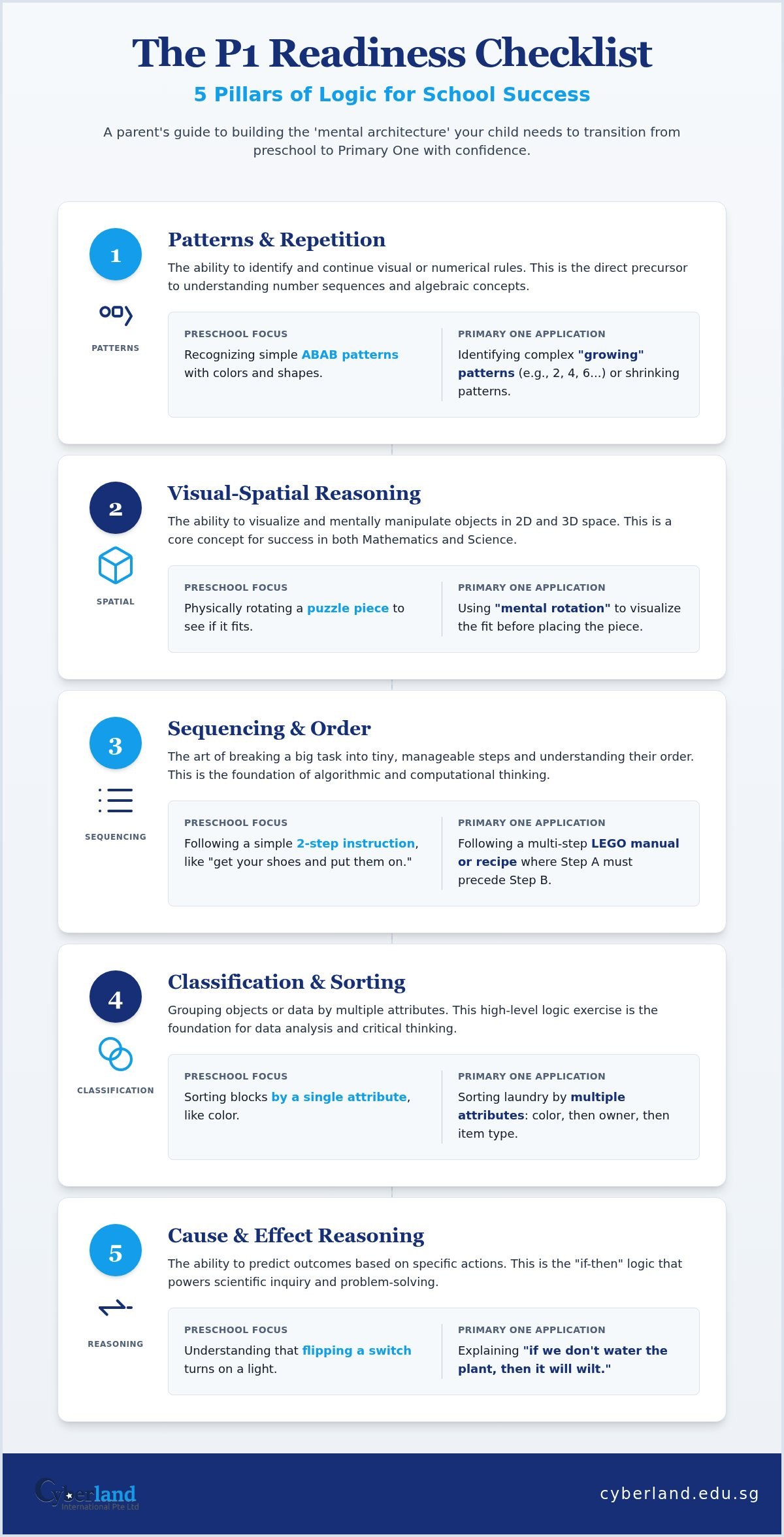
Patterns are everywhere. In preschool, children learn simple ABAB patterns using colors or shapes. In Primary One, they must identify "growing" patterns, like 2, 4, 6, or shrinking patterns in geometry. Recognizing these visual rules is the direct precursor to understanding number sequences and algebraic concepts later on. Spatial reasoning is equally vital. It's the ability to visualize and manipulate objects in 3D space. A practical check is simple. Can your child rotate a puzzle piece mentally before placing it? This "mental rotation" is a core engineering concept that sets the stage for success in both Math and Science.
Pillar 3 & 4: Sequencing and Classification
Sequencing is the art of breaking a big task into tiny, manageable steps. Think about following a recipe or building a LEGO set. This is actually algorithmic thinking. When a child understands that Step A must happen before Step B, they are learning the foundational logic of computer programming. Classification takes this further. It's about sorting data by multiple attributes. Sorting the laundry isn't just a chore; it's a high-level logic exercise when you ask them to sort by color, then by owner, then by item type. These critical thinking for early learners basics are the foundation for all advanced problem-solving.
Pillar 5: Cause and Effect
Finally, cause and effect allows children to predict outcomes based on specific actions. It's the "if-then" logic that powers the modern world. If I push this button, the robot moves. If I change this variable, the result shifts. In our Junior Programmer workshops, we see this ignite a child's eyes as they realize they can control a digital outcome through pure logic. This pillar ensures they aren't just guessing; they're thinking strategically about how their choices impact the world around them. Mastering these pillars ensures they enter the classroom ready for anything.
Fostering Logic Naturally: A Parent’s Checklist for Daily Life
Logic doesn't need a classroom to thrive. In fact, some of the best moments for preparing preschoolers for primary one logic happen right at the kitchen table or during the bedtime rush. It's about shifting from being a "provider of answers" to a "facilitator of thought." When we slow down and invite our children to solve small daily mysteries, we build their confidence. Understanding how children develop cognitive skills through their senses and language helps us see every interaction as a learning spark.
Turn mundane chores into high-stakes logic puzzles. Ask your child to pack the grocery bag so the eggs don't crush. Challenge them to organize their toy shelf by height, color, or frequency of use. If they get stuck, resist the urge to jump in immediately. Instead, ask, "What do you think happens if we put the heavy book on top of the soft bear?" This guides them through the thinking process without stripping away the joy of discovery. You are building their mental muscles one question at a time.
The Power of "If-Then" Thinking
Conditional logic is the backbone of clear reasoning. You can teach this through simple household rules. "If it rains, then we play inside." "If you finish your broccoli, then we have fruit." These aren't just rules; they are logical structures. By using this language, you're preparing them for Science "Experimental Variables" later in Primary school. Encourage your child to explain their "why" behind a decision. If they choose to wear boots on a sunny day, ask for their reasoning. Their answer might reveal a surprising and delightful logical path.
Strategic Play: Logic Games for 5 and 6-Year-Olds
Games are the ultimate playground for foresight. Classic choices like Tic-Tac-Toe or simplified Sudoku teach children to look two steps ahead. This develops the strategic "if-then" reasoning they'll need for P1 Math heuristics. While digital apps have their place, "unplugged" logic puzzles like tangrams or physical mazes are just as effective. They provide a tactile experience that grounds abstract concepts. For more play-based ideas, check out our guide on the best preschool enrichment Singapore families trust. Play is work for a child; let's make it count.
How STEM and Coding Accelerate Logical Readiness
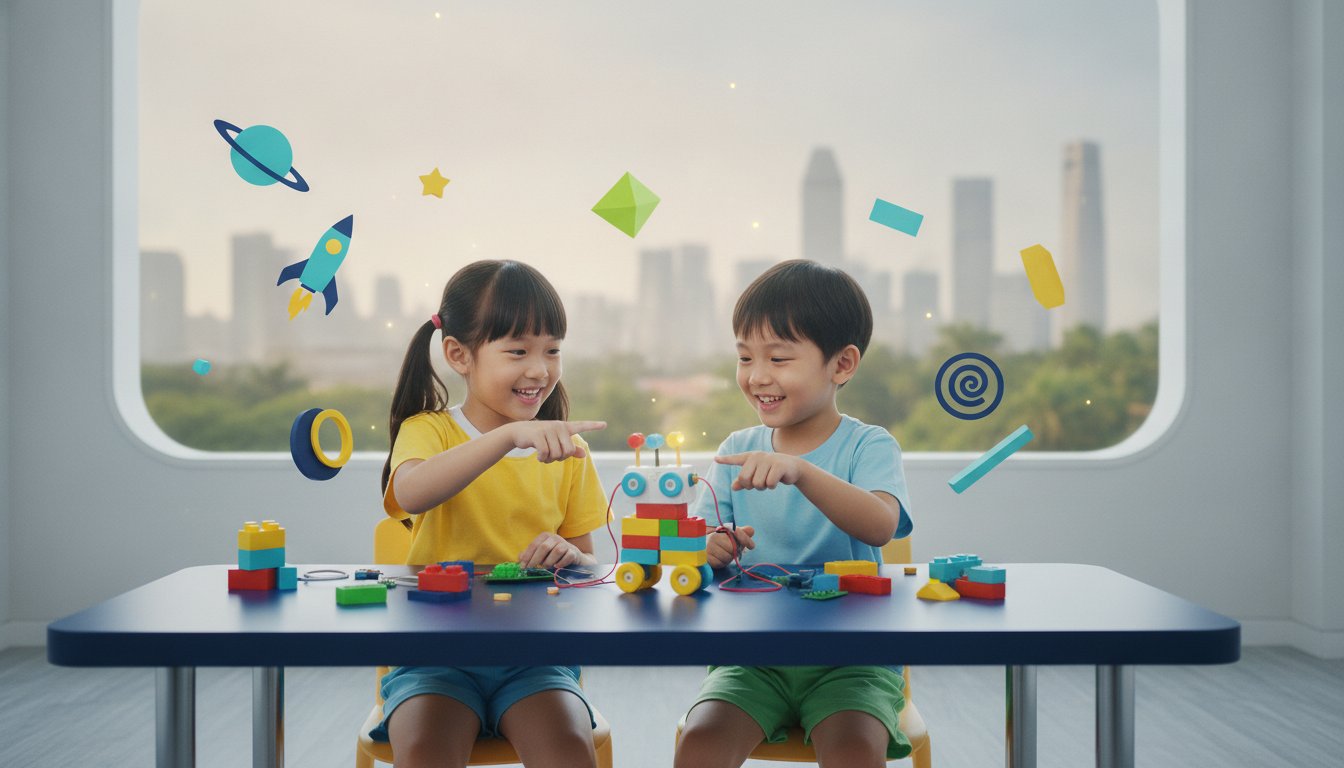
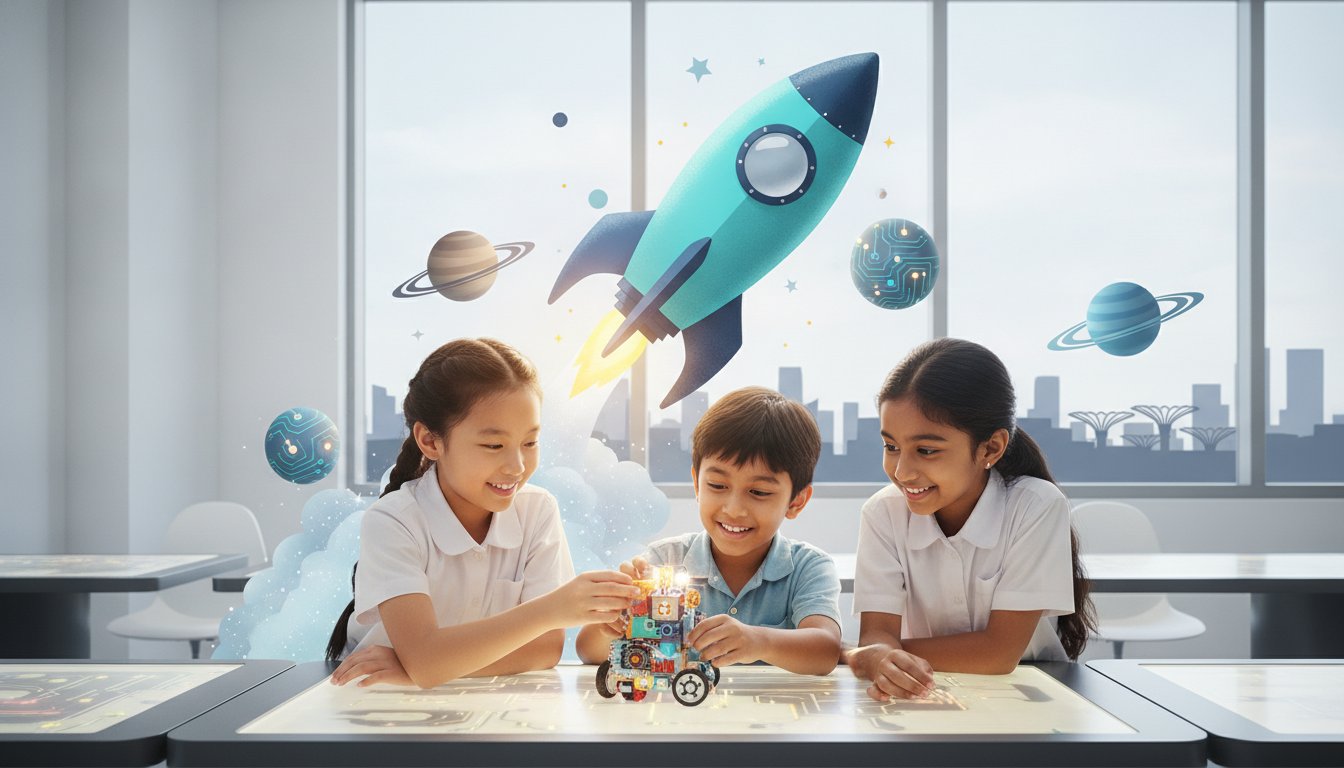
Logic can sometimes feel abstract. For a six-year-old, "structured reasoning" is a big concept to grasp. STEM and coding change that. They make logic visible. When a child builds a bridge or directs a robot, they see their thinking in action. Preparing preschoolers for primary one logic through these hands-on activities turns "if-then" theories into tangible results. It moves learning from the page to the real world. It's energetic, engaging, and deeply effective.
In our workshops, we treat failure as a friend. If a block tower falls or a code doesn't work, we don't call it a mistake. We call it a data point. This perspective is vital for the P1 transition. It teaches persistence. It shows children that a logical "error" is just a puzzle waiting for a new sequence. Robotics bridges this gap beautifully. It connects the silent thoughts in a child's head to the physical movement of a machine, making the abstract feel real.
Coding as a Language of Logic
Learning to code is actually learning to think with clarity. It requires precision. Our Junior Programmer course Singapore focuses on the "logic of instructions" through unplugged activities. This means children learn foundational coding blocks without staring at a screen. They master sequencing and loops by physically moving through paths. This clarity of thought is exactly what they need when tackling multi-step math problems in primary school. They learn to be concise, accurate, and methodical in every task they undertake.
Engineering the Thinking Process
Engineering challenges spark a different kind of fire. In our Junior Engineer programs for kids, we focus on building 3D spatial logic. Children don't just follow instructions; they solve problems through trial and logical adjustment. Can this structure hold weight? Why did it lean to the left? This process mirrors the heuristics they will face in P1 Math. It builds the mental rotation skills that ensure they can visualize solutions before they even pick up a pencil. It's about building a mind that doesn't give up when things get tricky.
Ready to ignite your child's curiosity and build these essential skills? Explore our Junior Programmer workshops and see logic come to life through play today.
Your 6-Month Roadmap to Primary One Logic Mastery
Success isn't built overnight. It's a steady, joyful climb. When you approach preparing preschoolers for primary one logic with a clear timeline, the process feels less like a chore and more like an adventure. This 6-month roadmap ensures your child develops the necessary "mental architecture" without feeling overwhelmed. We want them to arrive at the school gates with a spark of curiosity in their eyes and the tools they need to succeed.
Months 6-5: The Sorting Phase. Focus on classification. Use sensory-based puzzles and daily chores to help them categorize the world. Sorting laundry or organizing a toy box by multiple attributes builds the foundations of data processing.
Months 4-3: The Sequence Phase. Introduce "unplugged" coding concepts. Practice breaking tasks into three-step instructions. Help them see the logic in a recipe or the order of getting ready for bed. This develops the "if-then" reasoning they'll need for math heuristics.
Months 2-1: The Reasoning Phase. Move toward verbal logic. Ask them to explain why something happened. Practice multi-step instructions that require memory and focus. This mimics the fast-paced classroom environment they'll soon enter.
Month 0: The Confidence Phase. Shift the focus entirely to emotional readiness. Encourage them to ask "Why?" and "Can you help me?" Focus on the joy of discovery rather than getting every answer right.
The Final Countdown: Confidence over Content
Knowledge is important, but mindset is everything. A confident child who knows how to think will always outperform a child who has simply memorized the answers. In these final months, your role is to be a nurturing guide. Create an environment where "I don't know yet" is a perfectly acceptable starting point. Our workshops are designed to provide that final spark of interest. We turn abstract logic into a playground of robots and engineering challenges, ensuring children feel like bold innovators before their first day of school. A supportive atmosphere is the best preparation you can provide.
Building a Future-Ready Foundation
Logic is far more than a Primary One requirement. It's a lifelong skill that powers a permanent STEM mindset of curiosity and resilience. By teaching your child to identify rules and reach conclusions, you're giving them a lasting advantage in a changing world. Preparing preschoolers for primary one logic is just the first step in a much longer journey of transformation. Let's make sure that journey starts with enthusiasm and a sense of wonder. Join a Cyberland workshop to see logic in action and give your child the confidence to thrive!
Ignite Their Thinking Today
The transition to Primary One is a monumental milestone. It's a season of growth, wonder, and new beginnings. By focusing on the five pillars of logic, you're building a mental architecture that extends far beyond standard assessment books. You now have the tools to turn everyday chores and storytime into vibrant learning opportunities. Preparing preschoolers for primary one logic is truly about nurturing a resilient mindset that embraces every challenge as a puzzle to be solved.
We're here to be your supportive partner in this journey. Cyberland has been trusted by Singapore schools for over 20 years to spark curiosity in young minds. Our hands-on, play-based curriculum creates a nurturing environment for young innovators to explore and excel. We make complex reasoning feel like pure play. Ready to give your child a logical head start? Explore Cyberland’s Junior Programmer and Engineer workshops today!
The future is bright for your little learner. Let's ignite their potential together!
Frequently Asked Questions
Is my preschooler too young to learn "logic"?
Not at all! Children begin developing these skills as soon as they start asking "why" about the world. At age 5 or 6, logic is about identifying patterns and understanding simple rules. Preparing preschoolers for primary one logic is most effective when it feels like play. By encouraging them to sort toys or predict story endings, you are already teaching them the fundamentals of reasoning and structured thought.
What is the difference between logic and math for a 6-year-old?
Think of logic as the "engine" and math as the "vehicle." While math involves counting and calculations, logic is the ability to understand relationships and sequences. For a 6-year-old, math might be knowing that 2+2=4. Logic is understanding that if you have two apples and add two more, the total must increase. Logic provides the "why" behind the mathematical "how," making word problems much easier to solve.
How can I tell if my child is struggling with logical reasoning?
You might notice your child struggling if they find it hard to follow instructions with more than two steps. Another sign is difficulty recognizing basic ABAB patterns or an inability to explain why they made a specific choice. Don't worry if they hit roadblocks! These skills are like muscles that grow with practice. Using hands-on activities, like building with blocks, can help them visualize solutions and build confidence.
Does coding really help with Primary One Math?
Absolutely. Coding is essentially "applied logic." When children learn to code through programs like our Junior Programmer workshops, they master sequencing and decomposition. These are the same skills needed to break down a P1 math heuristic question. By seeing the immediate result of a logical instruction, children develop a deep, intuitive understanding of how rules work. This makes abstract math concepts feel much more familiar and manageable in the classroom.
What are some simple logic toys I can buy in Singapore?
Singapore has fantastic options for logic-building toys. Look for tangrams, which improve spatial reasoning, or magnetic tiles for 3D construction. Classic board games like Connect 4 or Guess Who are excellent for teaching strategy and deductive reasoning. You can find these at local retailers or specialty toy stores. Even simple "unplugged" puzzles like mazes or "spot the difference" books are powerful tools for sharpening a child’s focus and pattern recognition.
How much time should we spend on logic practice each day?
Consistency is much more important than duration. Just 15 to 20 minutes of intentional play each day can make a massive difference. This shouldn't feel like "homework." Instead, integrate logic into your daily routine. Ask a few "what if" questions during a car ride or play a quick round of a strategy game before bed. The goal is to keep the spark of curiosity alive rather than making it a stressful task.
Can logic skills be improved if my child is naturally more "creative"?
Creativity and logic are two sides of the same coin! A creative child often has a vivid imagination, which is a huge asset for "what if" reasoning. Logic simply provides a structure for that creativity to flourish. By preparing preschoolers for primary one logic, you aren't dampening their spirit; you are giving them the tools to turn their big ideas into reality. Many of the best engineers and programmers are deeply creative problem-solvers.
Are there specific P1 logic workshops in Ang Mo Kio?
Yes! Cyberland has a strong presence in Ang Mo Kio, where we offer specialized workshops like Junior Programmer and Junior Engineer. We have partnered with many local preschools and primary schools in the area for over 20 years. Our AMK location provides a convenient and nurturing space for neighborhood families to access high-quality STEM enrichment. It is a fantastic way to ensure your child is "future-ready" while staying close to home and community.

Comments