
Junior Engineer Programs for Kids: 2026 Guide

Updated: Aug 9
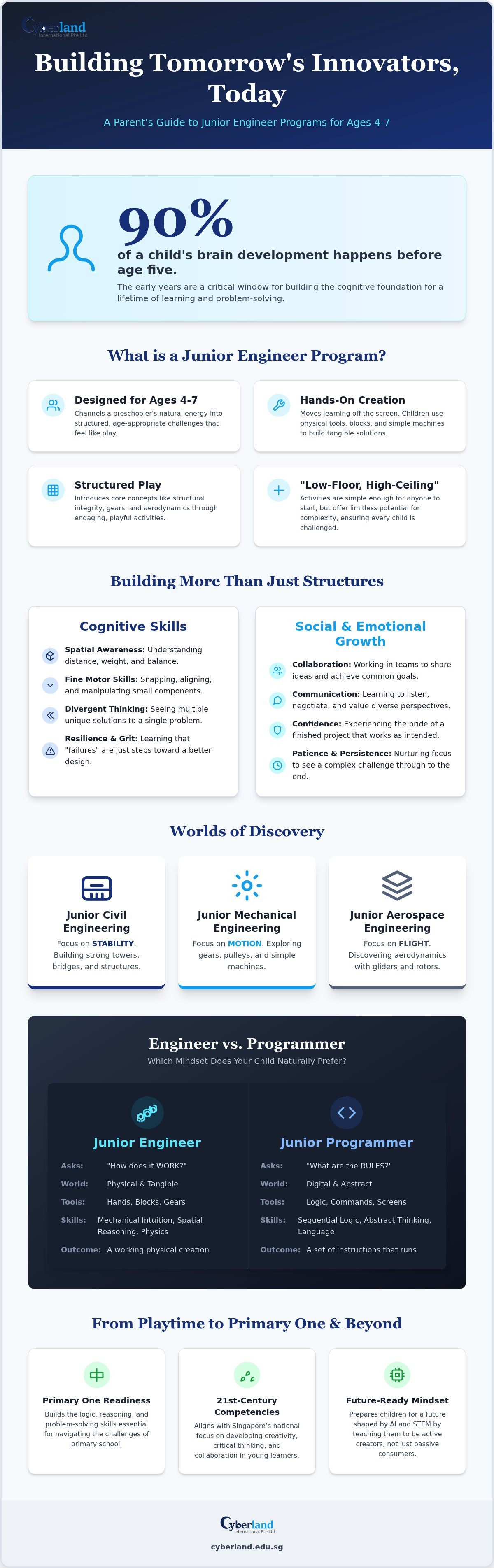
90% of a child's brain development happens before age five. It's a staggering reality. This fact highlights why the early years are so critical for building a foundation for the future. You want your child to excel in a world increasingly shaped by AI and STEM, but traditional tuition often leads to boredom and burnout. Finding premium enrichment near Ang Mo Kio that balances play with progress can feel like a challenge.
We believe that engineering is a mindset, not just a career. Choosing a junior engineer program for kids transforms everyday play into a masterclass in problem-solving. These sessions bridge the gap between natural curiosity and tangible technical skills. They prepare your child for the logic and reasoning required in Primary One while keeping the joy of discovery alive. Sparking interest now ensures they don't just keep up; they lead.
In this 2026 guide, we explore how hands-on STEMtastic workshops build confidence through creation. You will see how your child can develop a resilient, innovative mindset right here in Singapore. Let's turn that curiosity into a lifelong passion for growth.
Table of Contents
Why Start Now? The Power of Engineering for Young Minds
Curiosity is a child's natural superpower. Every "why" a four-year-old asks is the spark of an engineering journey. Engineering isn't just for adults in hard hats; it's the vibrant study of the "how" and "why" behind the world we touch. By enrolling in a junior engineer program for kids, you give your child the tools to decode their environment. They move from being passive observers to active creators. This shift is vital in a world that often prioritizes passive screen time over physical discovery.
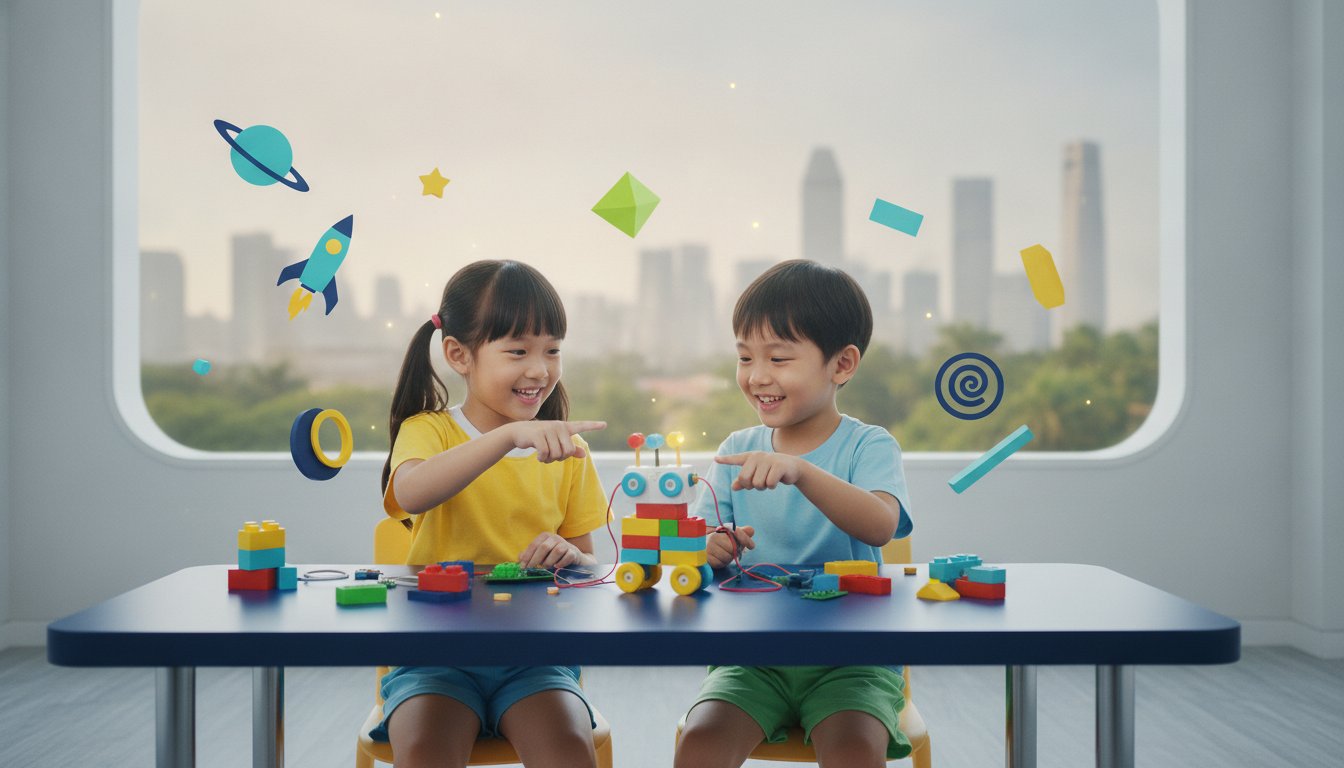
Tiny hands building tall towers are doing more than just playing. They're engaging in a rigorous brain workout. Through building, children develop spatial awareness by gauging distances, weight, and balance. They refine their fine motor skills as they snap components together or align gears. In our STEMtastic workshops, we see this transformation daily. Instead of swiping on a tablet, children are constructing physical solutions. This hands-on engagement builds a foundation that textbooks simply can't match.
We also believe that a collapsing bridge is one of the best things that can happen in a classroom. In a junior engineer program for kids, a "failed" build is actually a massive win. It's a data point that encourages a child to analyze, adapt, and try again. This builds a level of resilience and grit that will serve them for a lifetime. When they realize that mistakes are just steps toward a better design, their confidence soars.
The Cognitive Benefits of Early STEM Exposure
Early exposure to Science, technology, engineering, and mathematics (STEM) creates a lasting cognitive impact. It enhances divergent thinking, which is the ability to see multiple unique solutions to a single problem. Structural play also builds mathematical foundations like geometry and physics through lived experience. For our youngest learners, an engineering mindset is the joyful habit of seeing every hurdle as a puzzle that can be solved with a bit of imagination and logic.
Emotional Growth Through Collaborative Building
Building is rarely a solo sport. In our Ang Mo Kio sessions, children often work in teams to tackle larger challenges. They learn to listen to peers, share ideas, and negotiate toward a common goal. This collaborative environment boosts social confidence and teaches the value of diverse perspectives. Nurturing patience and persistence becomes natural when there is a tangible, finished project waiting at the end. The pride they feel when their creation finally works is truly transformative.
What is a Junior Engineer Program for Kids?
It isn't about blueprints and complex calculus just yet. A junior engineer program for kids is a specialized enrichment journey designed for the preschool and early primary years, specifically for children aged 4 to 7. At this age, kids are natural scientists. They want to touch, move, and disassemble objects to see how they function. This program channels that raw energy into structured play. It introduces core concepts like structural integrity and mechanical advantage through hands-on exploration. By using physical tools, oversized blocks, and simple machines, we make abstract ideas tangible.
We focus on "low-floor, high-ceiling" activities. This means the entry point is simple enough for any child to start, but the potential for complexity is limitless. One child might build a basic wall; another might add buttresses and a functional drawbridge. This approach ensures every child feels successful while remaining challenged. It mirrors the goals of the global national initiative to strengthen STEM education, which emphasizes making these subjects accessible and engaging from the very start of a child's schooling.
Foundational Modules: From Civil to Aerospace
Our curriculum is divided into exciting worlds of discovery that grow with your child's skills. In Junior Civil Engineering, the focus is on stability. Children learn why certain shapes, like triangles, are stronger than others as they build skyscrapers that stand tall. Junior Mechanical Engineering moves into the world of motion. Here, we explore how gears and pulleys work together to make heavy lifting easy. Finally, Junior Aerospace introduces the basics of flight. Kids experiment with aerodynamics to see exactly what makes a glider soar or tumble. Each module builds a different layer of the "engineering mindset" we discussed earlier.
The STEMtastic Workshop Experience
A STEMtastic workshop feels nothing like a traditional classroom. There are no rows of desks or silent lectures. Instead, the room is filled with the sounds of clicking blocks and collaborative chatter. Our facilitators act as mentors rather than lecturers. They don't just provide answers; they ask guiding questions like, "What happens if we move this gear to the other side?" to spark independent discovery.
A typical 60-minute session follows a purposeful, high-energy rhythm:
The Hook (10 mins): An engaging story or a real-world problem that needs a solution.
The Build (30 mins): Active, hands-on construction using specialized engineering kits.
Testing and Refinement (15 mins): Seeing the creation in action and figuring out how to make it better.
Reflection (5 mins): Sharing "wins" and discussing what the builders learned during the process.
This organized flow ensures that every child stays moving and thinking. If you are ready to see your child's curiosity turn into real-world skill, you can explore our Junior Engineer modules to see how we bring these sessions to life in Ang Mo Kio.
Junior Engineer vs. Junior Programmer: Which is Right for Your Child?
Choosing between building a physical bridge and writing a digital line of code isn't always a simple decision. Many parents see these as the same thing, but they spark very different neural pathways. A junior engineer program for kids focuses on physical hardware and structural logic. It's about gravity, friction, and how things hold together in the real world. In contrast, a Junior Programmer module dives into virtual logic. It deals with sequential instructions and if-then statements. Both are vital parts of a modern education, but the starting point often depends on your child's developmental stage.
Most children benefit from mastering the physical before moving to the virtual. Physical engineering provides immediate, tactile feedback that a screen cannot replicate. When a gear doesn't turn or a tower leans, the child sees the cause and effect instantly. This grounded understanding of how things work creates a solid foundation for more abstract digital concepts later on. Eventually, these two disciplines merge in the world of robotics. This is where a physical "body" meets a digital "brain."
Physical vs. Digital Problem Solving
Tactile feedback is essential for younger learners, especially those around age four. Their brains are wired to learn through touch and movement. Engineering provides this sensory-rich environment. According to a profile by Harvard's Global Education Innovation Initiative, these types of structured programs help develop cognitive competencies by engaging children in construction and real-world design. Digital logic is brilliant, but it's more abstract. We recommend a balanced STEM diet. Start with the physical "how" in our Junior Engineer sessions before introducing the digital "why" of programming. This ensures your child isn't overwhelmed by screen-based logic too early.
Identifying Your Child's Natural Interests
Watch how your child plays at home. Does your little one spend hours building elaborate cities with blocks? They might have a "Maker" personality. These children thrive on the feel of materials and the satisfaction of a finished, physical project. Do they prefer solving puzzles or organizing toys into complex, rule-based systems? They might be a natural "Coder." They enjoy the sequential logic of how things behave rather than just how they look.
At Cyberland, our modules are designed to let kids explore both paths without pressure. We don't believe in pigeonholing a child too early. By trying both a junior engineer program for kids and our programming modules, they discover where their true passion lies. Our facilitators in Ang Mo Kio are trained to spot these natural leanings, helping you guide your child's growth with confidence and joy.
Singapore Parents Guide: STEM Readiness for Primary School
Primary One isn't just about bigger bags and new uniforms. It's a significant cognitive leap. In Singapore, the Ministry of Education (MOE) increasingly emphasizes 21st-century competencies like critical thinking and adaptability. This is where a junior engineer program for kids becomes an essential bridge. By introducing technical concepts early, we help children transition from simple play to purposeful, "Applied Learning." This hands-on approach mirrors the local curriculum's shift toward practical problem-solving. It ensures your child isn't just memorizing facts but understanding how the world actually functions.
Early exposure is the best antidote to "P1 Anxiety." Many children feel overwhelmed when they first encounter formal science or complex mathematical logic. However, a child who has already built a functional pulley or stabilized a bridge has a massive head start. They've already mastered the foundational concepts. When these topics appear in a textbook, they feel familiar and exciting rather than intimidating. This familiarity breeds a quiet confidence that allows them to excel from day one.
Building Logic and Reasoning Skills
Modern math in Singapore requires more than just arithmetic. It demands "if-then" logic. If a structure is top-heavy, then it will tip. This is the exact reasoning used in our Junior Engineer modules to foster independent thinking. We encourage children to ask their own questions and test their own theories. This prepares them for the rigors of primary school science, where hypothesis testing becomes a core part of the syllabus. They learn to think like scientists before they even step into a lab.
Why Ang Mo Kio is a Hub for Tech Enrichment
Location matters for busy Singaporean families. Cyberland is strategically located in Ang Mo Kio Industrial Park 2, making premium tech enrichment accessible in the heartlands. Our deep partnerships with local preschools and primary schools serve as a mark of quality and trust. We understand the specific needs of students in this community. By bridging the gap between preschool exploration and formal primary education, we ensure no child falls behind in STEM literacy. It's about providing world-class opportunities right in your neighborhood.
Ready to give your child a head start in their academic journey? Secure their spot in our next Junior Engineer intake and watch their confidence soar as they master new skills.
Cyberland Junior Engineer: Sparking Curiosity in the Next Generation
Ignite interest. Build confidence. Shape the future. Cyberland stands as a bold innovator in Singapore's education landscape. We aren't a detached service provider. We are your supportive partner. Our junior engineer program for kids is more than a class; it's a launchpad for young minds. We blend professional educational authority with a warm, inviting atmosphere. This unique approach is why numerous schools across the island partner with us for our STEMtastic workshops. They recognize the quality of our interactive, hands-on modules. We don't just deliver content. We nurture the next generation of visionary thinkers.
Our modules, including Junior Engineer and Junior Programmer, are designed specifically for children aged 4 to 12. We deeply understand child psychology and developmental milestones. This expertise allows us to present complex ideas with playfulness and accessibility. By joining Cyberland, your child enters a vibrant community of young innovators. They are surrounded by peers who share their curiosity and parents who value forward-thinking learning. It's a space where discovery is celebrated every single day.
Our Hands-on Learning Philosophy
Energy. Momentum. Discovery. Our workshops favor brevity and impact. We utilize short, punchy activities to keep children engaged and excited. Long, dry explanations have no place here. Instead, we prioritize direct action in our builds. We make technical concepts accessible through vibrant, sensory-focused language. Every child leaves our session with a tangible sense of wonder. They realize that they can be the architects of their own ideas. This is the Cyberland promise: a positive trajectory for every child's development and a lifelong passion for growth.
How to Get Started with Cyberland
Ready to begin? Enrolling is a seamless process. You can visit our enrichment centre located in Ang Mo Kio Industrial Park 2. It's a professional yet friendly environment where big ideas come to life. We also offer specialized Nursery Enrichment and Kindergarten Enrichment modules that can be integrated into school schedules. If you are an educator or a parent wanting to bring these opportunities to your local preschool, we are here to help; for those who also need custom-branded materials or banners for their educational events, you can check out 2B Printing for professional local services. We bridge the gap between curiosity and technical skill with ease.
The future belongs to the curious. Give your child the tools they need to solve problems with confidence and creativity. Contact us to spark your child’s engineering journey!
Empower Your Child to Build the Future
The journey from a simple "why" to a complex "how" is a beautiful transformation. You've seen how a junior engineer program for kids does more than teach building; it cultivates resilience and logic. By choosing the right path now, you're preparing your child for the academic leaps of Primary One and beyond. They move from passive screen use to active, tangible creation. This foundation is the key to thriving in an increasingly technical world.
As a trusted partner of Singapore preschools, Cyberland is committed to this growth. Our specialized STEMtastic curriculum is delivered by expert facilitators in Ang Mo Kio who truly care about every child's spark. We bridge the gap between early curiosity and real-world technical skills. Your child's potential is limitless when they have the right guide by their side. We are ready to help them discover the joy of innovation and the power of their own ideas.
Ignite your child’s curiosity-explore our Junior Engineer modules today!
Let's start this exciting adventure together. The world is waiting for the next generation of builders, and your child is ready to lead the way. Every great structure starts with a single block, and every great mind starts with a single spark of wonder.
Frequently Asked Questions
Is my 4-year-old really ready for an engineering program?
Yes, children are natural engineers from the moment they start exploring their environment. At age four, their brains are rapidly developing spatial reasoning and fine motor skills. Our junior engineer program for kids uses age-appropriate, larger components that are easy for small hands to manipulate. We focus on play-based discovery rather than complex theory, ensuring every child feels successful and inspired from their very first build.
What is the difference between STEM and a Junior Engineer class?
STEM is the broad umbrella covering Science, Technology, Engineering, and Mathematics. A Junior Engineer class is a specific, hands-on application of these subjects that focuses on structural and mechanical logic. While STEM provides the theoretical framework, our classes turn those concepts into tangible projects. Children don't just learn about gravity; they build a tower and see it in action. It's the difference between hearing a story and living it.
How do Junior Engineer modules help with Primary One preparation?
Our modules build the "if-then" logic and resilience required for the Primary One curriculum. By solving physical puzzles, children develop the mental stamina needed for modern Singapore math and science. They learn to follow sequential instructions and troubleshoot when things don't go as planned. This early exposure reduces academic anxiety and gives them a quiet confidence when they encounter formal technical concepts in school.
Can I enroll my child in both Junior Engineer and Junior Programmer modules?
We highly encourage a balanced STEM diet that includes both physical and digital logic. Enrolling in a junior engineer program for kids alongside our programming modules provides a holistic view of technology. It's helpful to start with the tactile feedback of engineering before moving into screen-based logic. This dual approach helps you identify if your child leans more toward being a "Maker" or a "Coder" while keeping their learning journey diverse and exciting.
Where are the Cyberland workshops located in Singapore?
Do children need any prior technical knowledge to join?
No prior knowledge is required to join any of our introductory modules. We design our sessions with a "low-floor, high-ceiling" philosophy, meaning we start with the basics and grow with your child. Every session begins with a clear, engaging hook that explains the day's goal. Whether your child is a building enthusiast or brand new to STEM, our facilitators ensure they feel supported and capable throughout the entire process.
What is the duration of a typical Junior Engineer enrichment session?
A typical session lasts approximately 60 minutes. We've designed this timeframe to match the attention spans of young learners while maintaining high energy and momentum. The hour is divided into purposeful segments: a 10-minute introduction, 30 minutes of active building, and 20 minutes for testing and reflection. This brisk rhythm keeps children moving and thinking without feeling overwhelmed by long periods of sitting.
How does Cyberland ensure the safety of children during hands-on builds?
Safety is our top priority in every workshop. We use specialized, age-appropriate building kits that are designed for safety and durability. Our expert facilitators maintain small group sizes to provide close supervision and personalized guidance for every child. We also ensure that the workshop environment is organized and spacious, allowing children to move and create freely without any risk. You can trust that your child is in a nurturing and secure space.
Comments