
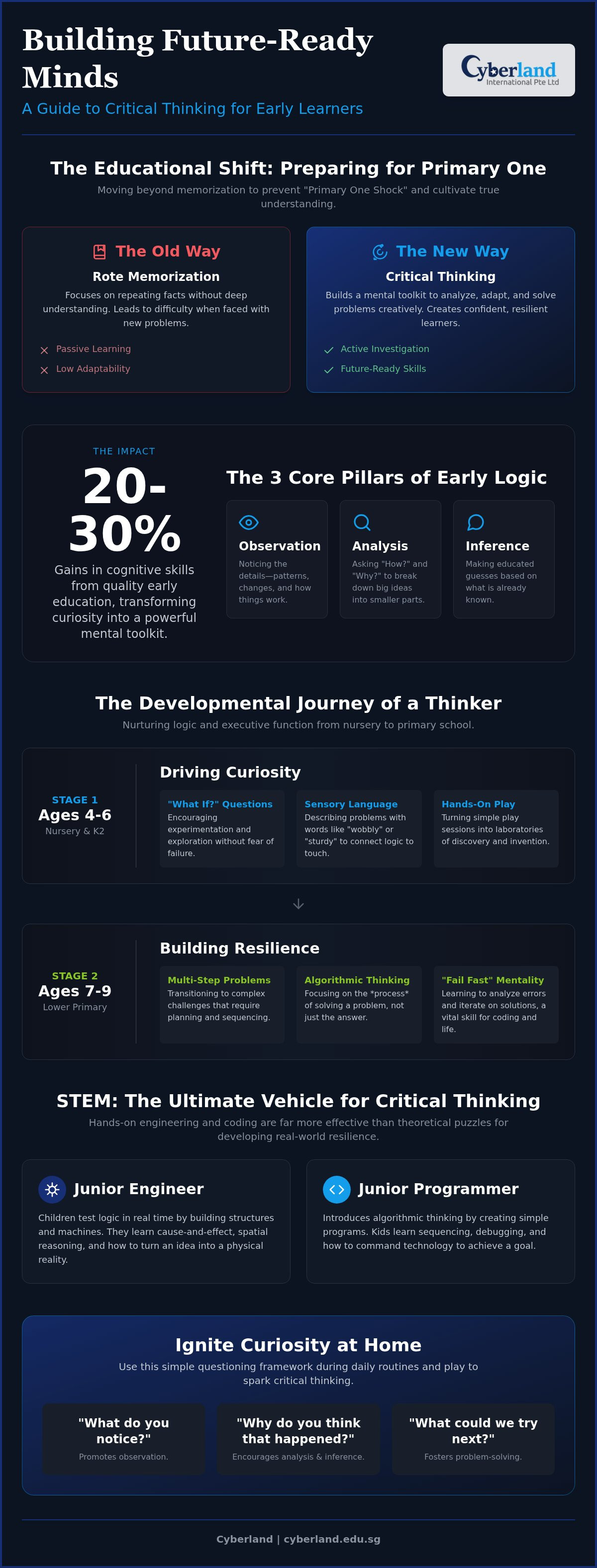
Critical Thinking for Early Learners: Building Success

Rote memorization is no longer the golden ticket to success. Today, the ability to analyze and adapt matters far more than the capacity to repeat. Developing critical thinking for early learners is the most effective way to bridge the gap between nursery play and Primary One rigor. Many parents feel a growing "Primary One shock" when traditional learning methods fall short. You want your child to be a confident problem-solver. A bold innovator. A curious explorer.
Research shows that quality early education can lead to 20-30% gains in cognitive skills. It transforms natural curiosity into a powerful mental toolkit. In this article, you'll discover how to nurture logical reasoning and creative problem-solving to prepare your child for the future. We'll provide a clear roadmap for cognitive development, share practical activities to spark wonder, and explain how hands-on STEM experiences build the mental resilience your child needs to thrive. Let's start this journey of discovery together.
Table of Contents
What is Critical Thinking for Early Learners?
Logic isn't just for adults. It's the secret sauce for every child's success. For young explorers, What is Critical Thinking? It is a mental toolkit that helps them evaluate the world around them. Instead of just accepting facts, they start to ask why. This shift from passive absorption to active investigation is the heart of critical thinking for early learners. It turns a quiet observer into a bold problem-solver.
The window between the ages of 4 and 8 is a golden opportunity. During these years, the brain is incredibly flexible. This is the peak time to build cognitive flexibility. We move away from the "repeat after me" style of traditional nursery settings because rote learning is a dead end. Curiosity is the real fuel. It ignites logical reasoning and keeps the engine of discovery running. When children are encouraged to think, they don't just learn; they grow.
The Core Pillars of Early Logic
Observation: It starts with noticing. A child sees a pattern in magnetic tiles or spots a change in how water flows. They learn to look closer and identify the details that others might miss.
Analysis: This is the "how" and "why" phase. Why did the bridge collapse? How does the gear turn the wheel? It's about breaking down big ideas into small, manageable parts.
Inference: This is the educated guess. If the sky turns grey, it might rain. If a robot doesn't move, the battery might be dead. It’s about using what they know to predict what they don’t.
Why Critical Thinking Matters in 2026
Singapore's education landscape is evolving rapidly. By 2026, the focus has shifted toward "future-ready" skills. The Ministry of Education (MOE) values thinkers over memorizers. Building these skills early prevents the "Primary One shock." This is the difficult moment when children transition from simple play to structured logic. Without a foundation in critical thinking for early learners, that jump feels overwhelming.
Practical application makes all the difference. Modules like Junior Engineer and Junior Programmer allow children to test their logic in real time. Beyond the classroom, these skills are vital for digital literacy. In an age of endless screen time, critical thinking helps kids question what they see online. They become savvy and resilient, rather than just tech-literate. They learn to navigate the digital world with a questioning mind and a confident heart.
Developmental Milestones: How Logic Grows from Nursery to Primary
Growth is a beautiful, non-linear journey. Every child develops at their own pace. In a nurturing environment, these small steps lead to giant leaps in understanding. The importance of teaching children critical thinking skills lies in building "Executive Function." Think of this as the brain's air traffic control system. It allows a child to plan, focus, and execute tasks without getting overwhelmed. It’s the essential foundation for all future academic success.
Logic evolves through specific, observable stages. It begins with simple cause-and-effect. A toddler learns that pushing a button makes a sound. For older children, this matures into complex sequencing. They start to understand that "Step A" must happen before "Step B" can succeed. This progression is the heart of critical thinking for early learners. It transforms a child from a passive recipient of information into an active architect of their own knowledge. By identifying these milestones, we can provide the right challenge at the right time.
Nursery & Kindergarten (Ages 4-6)
At this stage, curiosity is the primary driver. We focus heavily on "What if?" questions. What if we stack the blocks differently? What if we mix these two colors? We use sensory-focused language to describe problems. Is the structure "wobbly" or "sturdy"? This hands-on exploration builds the confidence to experiment. It turns a simple play session into a laboratory of discovery. Our Junior Engineer program for kids is designed specifically to capture this early spark and turn it into lasting logic.
Lower Primary (Ages 7-9)
As children enter Primary One, the academic landscape changes. The Singapore curriculum demands more independence and analytical depth. Students must transition to multi-step problem solving. This is where algorithmic thinking begins. It’s not just about getting the right answer; it’s about the process. We encourage kids to "fail fast." If a bridge collapses or a program glitches, they learn to analyze the error and try a different approach. This resilience is vital for navigating the MOE's logic requirements. We even introduce basic logic gates through physical play and simple coding to make abstract concepts feel real and accessible.
By understanding these milestones, you can better support your child's unique path toward mastery. If you're looking for a partner to guide this growth, you might want to explore our enrichment modules today.
STEM as the Ultimate Vehicle for Critical Thinking
Theoretical logic puzzles have their place. But they can't compete with the grit of a real-world challenge. STEM education provides a dynamic playground for critical thinking for early learners. When a child builds a robot or codes a sequence, they aren't just following instructions. They are evaluating, adjusting, and innovating in real time. The importance of teaching children critical thinking skills is best seen when a physical model fails and a child has to ask "why?" This is the "Cyberland Way." We blend technical rigor with the joy of creative discovery. In the context of STEM enrichment programs Singapore parents prioritize, this hands-on approach stands out as the most effective path to mastery.
Coding and Algorithmic Thinking
Coding is the language of logic. Through our Junior Programmer course Singapore, children master the art of sequencing. They learn that a computer only does exactly what it is told. This requires precision. If a character doesn't move as expected, the child enters the "debugging" phase. We treat debugging as a metaphor for life. It builds resilience. It teaches troubleshooting. Instead of getting frustrated, children learn to look for the "bug" in their logic. They move from being passive users of technology to active creators of solutions. They don't just play games; they build them.
Engineering and Spatial Reasoning
Building a bridge or a tower isn't just about stacking blocks. It's about 3D mental mapping. Engineering challenges force children to analyze weight, balance, and tension. When a structure wobbles, the "Junior Engineer" mindset kicks in. Everything can be improved. This constant cycle of testing and refining is critical thinking for early learners in its purest form. It links physical building to deep cognitive development. Children learn that failure is just another data point. They gain the spatial reasoning skills needed for complex math and science later in life. They become architects of their own success.
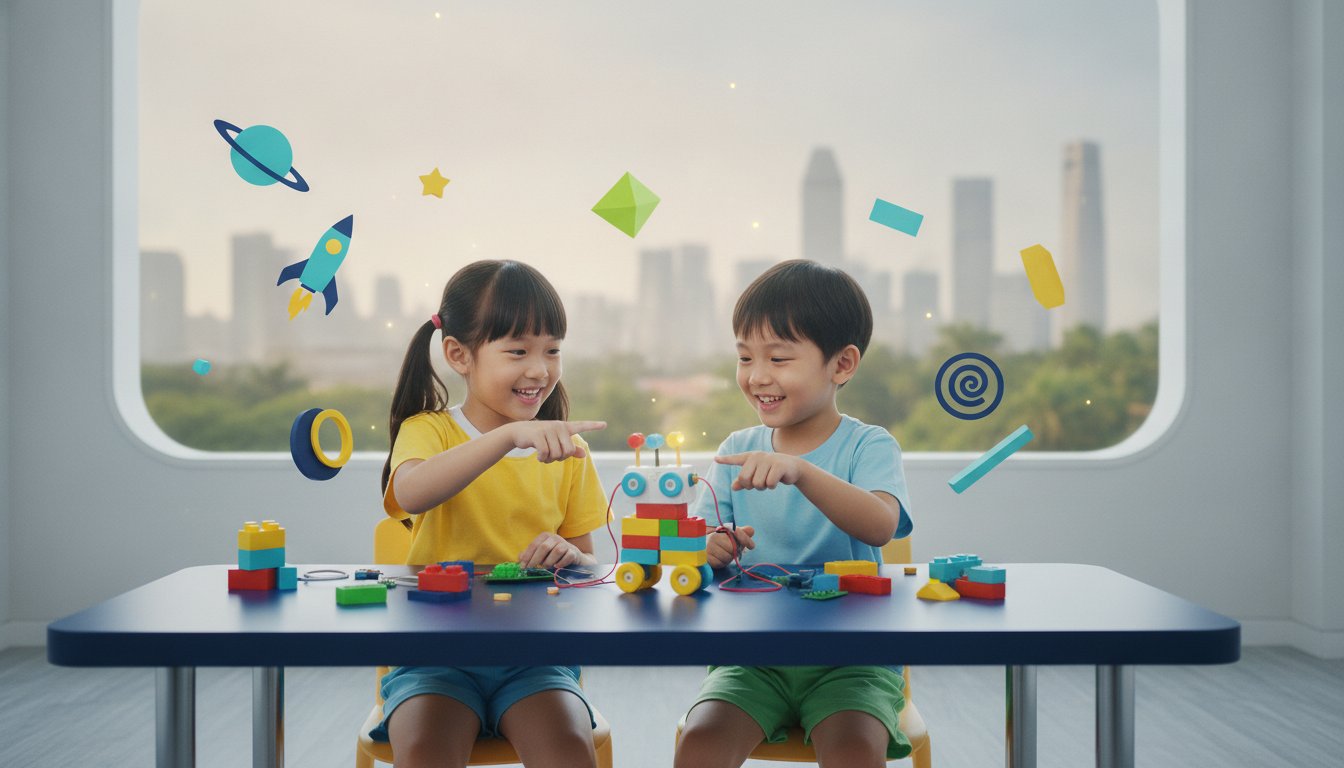
Practical Strategies for Parents to Foster Curiosity
Curiosity isn't a gift. It's a skill that you can nurture every single day through simple, intentional interactions. Parents are a child's first and most influential mentors. You don't need a high tech laboratory to build critical thinking for early learners. You just need a shift in perspective. By turning daily routines into moments of discovery, you help your child build the mental resilience needed for Primary One and beyond. It starts with stepping back and letting them lead the way.
The Power of Open-Ended Questions
Stop providing answers. Start asking questions. When your child picks up a cardboard tube, don't just say it's for the recycling bin. Replace "What is this?" with "How else could we use this?" This simple change pushes them to see potential in the ordinary. Ask them to predict outcomes before starting a task. If they are pouring water, ask, "How many small cups will it take to fill this big jar?" This process is known as scaffolding. Scaffolding is a parental support technique where you provide temporary assistance to help a child master a task they cannot yet do alone. It builds the bridge between what they know and what they are about to discover.
Creating a "Maker Space" at Home
You can spark engineering interest without spending a fortune. Dedicate a small corner of your home as a Maker Space. Fill it with low cost, high impact materials like tape, rubber bands, and recycled plastic bottles. Set a "Problem of the Week" for the family to solve together. For example, "How can we build a tower that holds a tennis ball using only newspaper?" This encourages critical thinking for early learners through tactile, physical play.
Don't be afraid of silence. We encourage "Purposeful Boredom" to allow children to invent their own solutions. When there is nothing to do, the brain works harder to create. Balance these physical experiences with digital tools, but ensure the focus remains on creation rather than consumption. When choosing the best preschool enrichment Singapore families often look for programs that mirror this home curiosity. If you want to see this philosophy in action, you can Join our next STEMtastic workshop and start your child's journey of discovery today.
Preparing for Primary One: The Cyberland Advantage
The transition to Primary One is a significant milestone. It's more than just a change of uniform. It represents a shift from the spontaneous play of preschool to the structured logic of the primary school curriculum. At Cyberland, we act as the vital bridge in this journey. We transform curiosity into competence. Our Junior Engineer and Junior Programmer modules are specifically designed to align with the 2026 MOE goals for future-ready learners. We don't just prepare children for a classroom. We prepare them for a lifetime of inquiry. By fostering critical thinking for early learners, we ensure that the jump to Primary One feels like a natural next step rather than a shock.
Environment matters. Our workshops are designed to be supportive, uplifting, and safe. We believe that a child who feels encouraged is a child who will take risks. We invite you to visit our centre in Ang Mo Kio Industrial Park 2 for a hands-on preview of our environment. See the vibrant energy. Witness the joy of discovery. It's a space where mistakes are celebrated as learning opportunities and where every question is a doorway to a new idea. This nurturing atmosphere is what sets the Cyberland experience apart.
Nurturing the "I Can" Attitude
Confidence is the foundation of logic. In our mentor-led workshops, we often see shy or hesitant learners transform into bold innovators. They learn that their ideas have value. This growth happens through collaborative problem solving with their peers. They don't just build robots; they build social resilience. They learn to listen, negotiate, and refine solutions as a team. Throughout their journey, they build a portfolio of "Junior Innovator" projects. These tangible results serve as a roadmap of their progress. They provide a sense of accomplishment that carries over into every other subject they study.
Partnering for Success in Singapore
We believe in the power of community. Cyberland actively partners with local preschools and primary schools to bring our STEMtastic workshops to life. This ensures that our enrichment remains relevant to the Singapore education landscape. The long-term benefits of early exposure to engineering and coding are clear. It builds a mental framework that supports math, science, and literacy. It isn't just about technical skills. It's about developing the grit and flexibility to thrive in an ever-changing world. We are committed to the success of the next generation of Singaporean thinkers.
The journey toward cognitive mastery starts with a single spark of interest. Don't wait for the Primary One transition to begin building these essential skills. Start now. Spark your child’s curiosity with Cyberland today!
Empowering the Next Generation of Thinkers
Building a foundation of critical thinking for early learners is the greatest gift you can give your child. We have moved beyond the limits of rote memorization. Active inquiry prepares young minds for the rigors of Primary One. By using STEM as a vehicle for discovery and implementing simple questioning strategies at home, you turn every challenge into a stepping stone. You aren't just teaching a subject. You are building a mental toolkit for life.
Cyberland is your partner in this transformation. As a trusted partner of Singapore preschools, we offer a purpose-built curriculum for ages 4-12. Our expert mentors in STEM and Robotics guide each child through hands-on Junior Engineer and Junior Programmer modules. We focus on the joy of discovery. We focus on the positive trajectory of your child's growth. The future belongs to the curious. Let's ignite that spark together.
Ignite your child’s curiosity—explore Cyberland’s 2026 STEM programs!
Your child's journey toward mastery starts today. We can't wait to see what they will discover next.
Frequently Asked Questions
Is my 4-year-old really ready for critical thinking classes?
Absolutely. The ages between four and eight are the peak window for building cognitive flexibility. At this stage, children are naturally curious and eager to explore cause-and-effect. Our Kindergarten Enrichment workshops use play-based discovery to introduce critical thinking for early learners without any academic pressure. We focus on "What if?" scenarios that spark wonder. It's about nurturing their natural instincts to investigate and solve simple problems in a supportive, mentor-led environment.
How does critical thinking help with Primary One preparation in Singapore?
It bridges the gap between preschool play and the structured logic of the MOE curriculum. Primary One requires students to analyze information rather than just memorize facts. By developing these skills early, children avoid the "Primary One shock" that occurs when rote learning fails. They enter the classroom with the mental resilience to handle multi-step instructions and complex sequencing. This foundation ensures they feel confident and capable from their very first day of school.
What is the difference between logic workshops and standard tuition?
Standard tuition often focuses on academic grades and syllabus mastery through repetition. In contrast, our logic workshops build the underlying "mental toolkit" a child needs to approach any subject. We prioritize the process over the final answer. Instead of finishing worksheets, children build physical models and code sequences. This hands-on approach encourages them to evaluate, adjust, and innovate. It's about teaching them how to think, not just what to think.
Can STEM activities improve my child’s language and communication skills?
Yes, because children must articulate their ideas to solve problems. Collaborative STEM tasks require peers to negotiate and explain their reasoning. We encourage using sensory-focused language to describe structural challenges, such as identifying if a bridge is "sturdy" or "wobbly." This strengthens their vocabulary and builds the confidence to speak up. They learn to communicate complex thoughts clearly, which is a vital skill for both social interaction and future academic presentations in school.
How can I tell if my child is developing strong critical thinking skills?
Look for a shift in how they approach challenges. A child developing critical thinking for early learners will start asking "why" and "how" instead of just "what." You might notice them trying a different approach when a toy breaks rather than getting frustrated. They begin to see patterns in their environment and make educated guesses about outcomes. These signs of "Executive Function" show they are planning and evaluating their actions with purpose and curiosity.
Do these workshops require any prior technical knowledge or coding skills?
No prior experience is necessary. We design our Junior Programmer and Junior Engineer modules to be accessible for absolute beginners. Our mentors guide children through the basics using intuitive, age-appropriate tools. Whether they are building their first structure or writing their first line of code, we meet them at their current level. The focus is on sparking interest and building confidence. Every child starts with a clean slate and leaves with a unique project.
What are some simple critical thinking activities I can do at home today?
Start with open-ended questions during daily routines. Ask, "How else could we use this spoon?" or "What do you think happens if we mix these colors?" You can also set up a "Problem of the Week" using recycled materials like cardboard and tape. Encourage them to build a tower that can support a small toy. These low-cost activities foster curiosity and allow children to test their logic through physical, tactile experimentation in a familiar setting.
Why is hands-on learning better than digital apps for early logic?
Physical building requires constant evaluation of weight, balance, and tension. Unlike a digital app, where a reset button erases mistakes, hands-on learning forces children to troubleshoot real-world consequences. It builds 3D mental mapping and spatial reasoning skills that screens cannot replicate. Tactile experiences also foster greater resilience. When a physical tower collapses, the child must analyze the structural failure and try again. This grit is the core of true logical development and creative problem-solving.


Comments