
Igniting STEM Interest: 2026 Guide for Singapore Parents

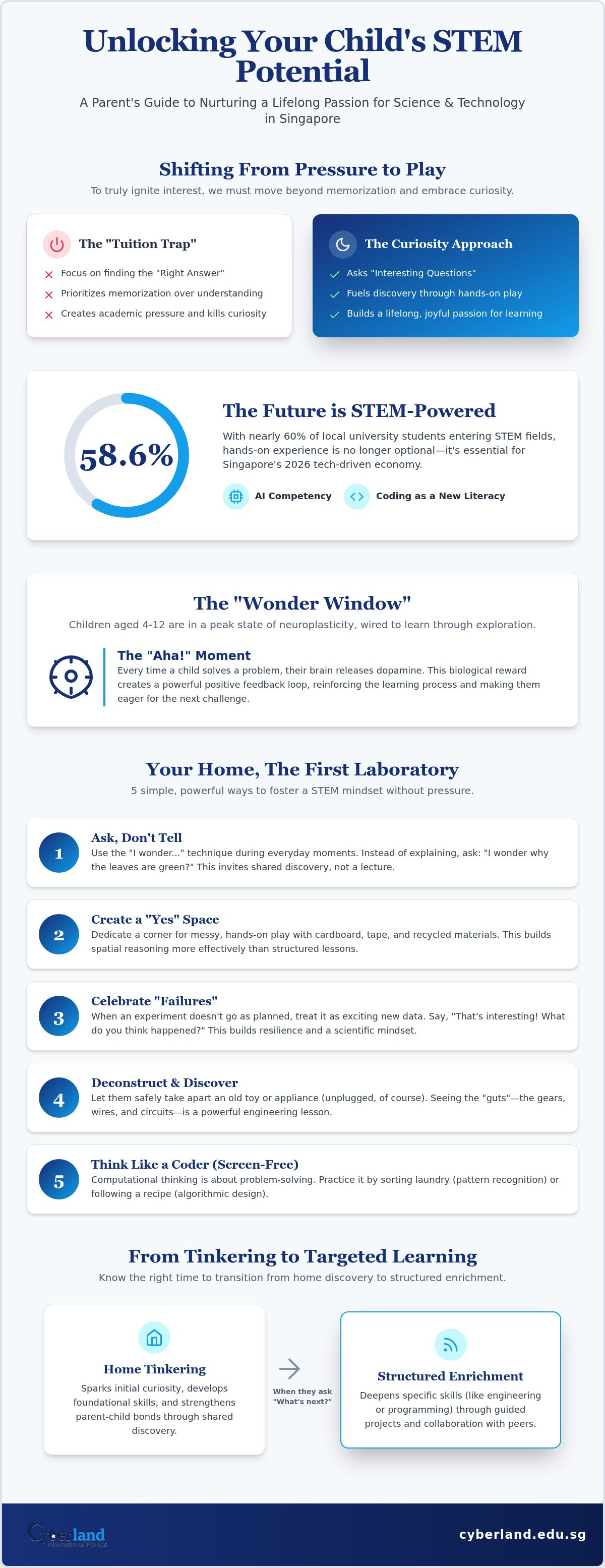
What if the secret to your child’s success in Singapore’s 2026 tech-driven economy isn't found in a thick textbook? It might actually start with a messy pile of cardboard and a "why" that never ends. As a parent, you want to ignite interest in STEM without adding to the mounting academic pressure. With 58.6% of local university students now entering STEM fields, the pressure to keep up is real. You don't want your child to fall behind. But between long office hours and the lure of screens, finding time for complex home experiments feels impossible.
It's okay to step away from the stress. You can spark wonder through simple, play-based discovery that feels like fun, not extra work. This guide shows you how to nurture a child who spontaneously asks "how" things work. We will explore practical strategies to build a lifelong passion for science and technology. You'll gain the confidence to choose the right enrichment programs and find joyful ways to bond through learning. Let's turn curiosity into a superpower together.
Table of Contents
Beyond the Classroom: Why Traditional Methods Often Fail to Ignite Interest in STEM
In Singapore, we often equate learning with results. We see a worksheet filled with correct answers and think the job is done. But a child who can recite the water cycle perfectly might not actually care about how rain forms. This is the "Tuition Trap." When we prioritize memorization, we accidentally kill the natural curiosity required for real scientific thinking. To truly ignite interest in STEM, we have to move beyond the textbook.
Genuine passion is different from academic performance. A student might score an A+ in mathematics but dread the thought of solving a real-world engineering problem. Understanding what STEM is involves realizing it's a way of thinking, not just a list of facts. The Ministry of Education's "Joy of Learning" initiative recognizes this. It encourages a shift toward exploration and discovery. We need to value the "Interesting Question" more than the "Right Answer."
The Pressure Problem in Singapore
Many parents feel the urge to turn every activity into a P1 preparation drill. We over-explain. We jump in to correct a child before they’ve had a chance to wonder. This creates a "Discovery Gap," which is the widening distance between a child's natural urge to explore and the structured, answer-driven environment of traditional schooling. Early exposure should feel like an adventure. It shouldn't feel like another hour of desk work. Play is the highest form of research for a young mind.
Reframing STEM as Everyday Magic
Start seeing science as a part of daily life. It’s in the way sourdough rises or how a toy car zooms across the floor. When an experiment "fails" at home, celebrate it. That’s not a mistake; it’s critical data. This mindset shift is the best way to ignite interest in STEM without the weight of expectations. When children see that you don't have all the answers, they feel safer to explore their own.
Ask "I wonder why" instead of giving a lecture.
Treat the kitchen as a laboratory for chemistry.
Let them take apart an old, safe appliance to see the "guts."
Celebrate the mess as a sign of active learning.
When STEM becomes recreational for the whole family, the pressure disappears. The spark stays lit because it's fueled by joy, not just a grade on a report card. You are building a foundation of confidence that will carry them through more rigorous studies later in life.
The Science of Curiosity: How Young Minds Connect with STEM
Children aged 4 to 12 are in what experts call the "Wonder Window." During these years, neuroplasticity is at its peak. Their brains are literally wired to absorb new concepts through exploration. Every time a child connects a circuit or builds a stable tower, they experience a rush of dopamine. This "Aha!" moment is more than just a happy feeling. It's a biological reward that reinforces the learning process. It creates a positive feedback loop that helps ignite interest in STEM naturally. By 2026, coding has evolved into a new form of literacy. Just like reading and writing, it allows children to express ideas and solve problems. This global shift is supported by programs like the national STEM education initiative, which highlights the critical role of early engagement in building a future-ready generation.
Building Blocks of Engineering for Kids
Engineering doesn't start with a degree. It starts with a pile of blocks on the living room floor. When a child stacks, balances, and eventually knocks things down, they are mastering the basics of structural understanding. They're learning about gravity and tension through their fingertips. This physical manipulation builds spatial reasoning in a way that digital apps simply cannot replicate. These early wins develop the fine motor skills and technical confidence needed for more complex tasks later on. For parents looking to channel this natural curiosity, our Junior Engineer Programs for Kids: 2026 Guide offers a structured path to turn play into expertise.
Computational Thinking Without a Screen
Many parents in Singapore worry about the impact of excessive screen time. Fortunately, the foundation of technology isn't actually a screen. It's computational thinking. This is a problem-solving framework that involves decomposition, pattern recognition, and algorithmic design. For a preschooler, this looks like sorting laundry or following a multi-step craft project. These "unplugged" activities are vital. They build the logic and reasoning skills that ensure P1 readiness without needing a device. It’s about teaching the brain how to process information systematically and efficiently. If you want to ignite interest in STEM early, focus on these tactile, real-world puzzles first. You can witness this growth firsthand in our Junior Programmer sessions, where we bridge the gap between logic and creation.
Choosing the Right Spark: DIY Experiments vs. Professional Enrichment
Sparking a child's curiosity often begins at the kitchen table. DIY experiments are wonderful for immediate bonding. They're low-cost and accessible. However, there comes a point where home tinkering reaches a natural limit. To truly ignite interest in STEM, children eventually need more than vinegar and baking soda. They need challenges that scale with their growing abilities. While home play builds the foundation, professional enrichment provides the structure needed to turn a fleeting hobby into a deep-seated passion.
One major difference is the social environment. In a workshop setting, children aren't just learning from an adult. They're collaborating with peers. They see other kids solving the same puzzles in different ways. This peer interaction makes science feel "cool" and social rather than solitary. When your child starts asking for more complex projects or shows a deep interest in how software works, it might be time to level up. This is the perfect moment to consider a formal junior programmer course Singapore parents trust to bridge the gap between play and skill.
This emphasis on collaboration is just as important for adults as it is for children. For parents working in remote or hybrid environments, Jelly Donut Events provides engaging virtual team-building experiences that help maintain that same sense of connection and shared problem-solving.
What to Look for in a STEM Provider
Not all programs are created equal. Some focus on demonstrations where children simply watch an instructor. Avoid these. Look for "hands-on" styles where your child is the one holding the tools. A high-quality provider uses a mentor approach rather than a traditional teacher role. This means they guide discovery instead of just giving answers. Check the teacher-to-student ratios too. Smaller groups ensure your child gets the guidance they need to navigate tricky engineering hurdles without feeling frustrated. The goal is to ignite interest in STEM by building confidence, one successful project at a time.
The Role of Specialized Equipment
Professional-grade robotics and engineering kits offer possibilities that household items can't match. These tools are designed to teach specific concepts like torque, gear ratios, or logic gates. High-quality kits are durable and precise. They allow for repeatable experiments and more complex builds. In Singapore, safety is a top priority. Reputable enrichment centers adhere to strict safety standards, ensuring that even the most "explosive" chemistry or high-speed robotics remain safe for young explorers. Using real equipment makes children feel like real scientists. It validates their efforts and makes the learning experience feel significant and professional.
Prioritize centers that offer trial sessions to gauge your child's interest.
Ensure the curriculum aligns with developmental milestones for ages 4 to 12.
Look for programs that offer a clear progression from basic tinkering to advanced modules.
By choosing the right environment, you provide the oxygen that keeps the fire of curiosity burning. You move from "watching" science to "doing" science. This transition is vital for long-term engagement.
Step-by-Step: 5 Practical Ways to Foster a STEM Mindset at Home
You don't need a high-tech lab to ignite interest in STEM. Your home is already full of scientific possibilities. It starts with a shift in your daily environment and how you interact with your child’s questions. Here are five simple steps to build a curious mindset today.
Step 1: Create a "Yes" Space. Set aside a specific corner, even in a compact HDB, where mess is allowed. This is where cardboard, tape, and old containers live. When a child has a space where they don't have to worry about the floor, they feel free to experiment.
Step 2: Use the "I Wonder" technique. When your child asks a question, don't give the answer immediately. Say, "I wonder why that happens? How can we find out together?" This prompts them to investigate rather than just consume information.
Step 3: Introduce "Tinker Hours." Dedicate one hour a week to building. Use recycled materials like egg cartons or Milo tins. These low-cost materials remove the fear of "breaking" expensive toys.
Step 4: Connect to existing passions. If they love baking, talk about the chemistry of yeast. If they love dinosaurs, explore the physics of how such large creatures moved.
Step 5: Celebrate persistence. Instead of saying "you're so smart," try "I love how you didn't give up when that bridge fell." This builds the resilience needed for complex problem-solving.
Fostering Curiosity in Preschoolers Naturally
Preparing for Primary One Logic
Success in P1 often depends on logic and reasoning. You can build these skills through simple sequencing games. Ask your child to arrange their toys from smallest to largest or by color patterns. This mirrors the basic logic used in coding. During storytime, pause and ask what they think will happen next. This predictive exercise is the essence of the scientific method. It prepares them for the rigors of formal education while keeping the joy of discovery alive. Ready to see your child lead the way? Explore our hands-on workshops at Cyberland to ignite interest in STEM today.
From Curiosity to Competence: The Cyberland STEMtastic Approach
Transitioning from home-based "tinker hours" to a structured environment is where curiosity transforms into competence. At Cyberland, we believe every child possesses a natural spark. Our mission is to ignite interest in STEM by providing the specialized tools and mentorship that are often hard to replicate at home. We turn "what if" into "I can." Our workshops are designed to be the vital bridge between a messy kitchen experiment and a sustainable, lifelong skill set.
The Junior Engineer journey is a perfect example of this growth. Children move beyond simple blocks to explore real mechanics and structural integrity. They build, test, and refine their creations. This iterative process builds a deep sense of technical confidence that stays with them. In our Junior Programmer module, we make coding feel like a genuine superpower. We don't just teach lines of code. We give children the agency to design, create, and control their own digital worlds. It's about moving from being a passive consumer of technology to an active creator.
We believe in community-wide impact. Cyberland proudly partners with local preschools and primary schools across Singapore to bring these experiences to as many children as possible. By grounding our programs in the local educational landscape, we ensure our curriculum remains relevant and supportive of school-based learning. We are here to be your partner in this journey, helping your child navigate the 2026 tech landscape with joy and ease.
Hands-on Learning for Children in Ang Mo Kio
Located in Ang Mo Kio Industrial Park 2, our local center serves as a vibrant hub for young innovators. Our unique "STEMtastic" methodology focuses on three core pillars: exploration, application, and reflection. We provide the professional-grade robotics and engineering kits that allow for high-level discovery. It's a space where "failure" is celebrated as a critical data point. For a deeper look at how these programs fit into your child's development, read our STEM Enrichment Programs in Singapore: A Parent’s 2026 Guide.
Join the Cyberland Community
Starting early makes a significant difference in long-term success. Our Nursery Enrichment and Kindergarten Enrichment modules are designed specifically for the unique developmental needs of ages 4 to 12. These early experiences do more than teach facts. They shape future career aspirations and build the resilience needed for a rapidly changing world. When you ignite interest in STEM during these formative years, your child enters the education system with a massive head start. They don't just keep up with the curriculum. They lead it. Enrollment for our upcoming sessions is now open. Ignite your child’s interest today.
Build a Future-Ready Foundation Today
Transitioning from simple curiosity to real-world competence is the most exciting journey a child can take. You've discovered how to move beyond the "Tuition Trap" by fostering a home environment that celebrates questions over correct answers. By using "Yes" Spaces and daily routines to ignite interest in STEM, you are already building the logical reasoning your child needs for the 2026 landscape. Now, it's about giving that spark the professional mentorship it needs to grow.
With over 20 years of experience in Singapore schools, Cyberland provides the expert guidance and specialized equipment that makes science feel like magic. Our curriculum is specifically designed for children aged 4 to 12. We ensure every workshop is a joyful, low-pressure experience. Conveniently located in Ang Mo Kio, our center is ready to welcome your young innovator into a community of curious peers. The road to innovation starts with a single "why." Let's help your child find the answer together.
Ignite your child’s curiosity with Cyberland’s STEMtastic workshops!
Your child’s journey of discovery is just beginning. We can't wait to see where their imagination takes them next.
Frequently Asked Questions
At what age should I start introducing STEM to my child?
Early childhood is the perfect time to start, specifically around age four. At this stage, children are naturally curious and their brains are incredibly adaptable. Introducing basic concepts through play helps ignite interest in STEM before any academic pressure begins. Focus on sensory experiences like water play or building blocks. These simple activities lay a solid foundation for more complex logical thinking later in their education.
Is coding too difficult for a preschooler to understand?
Not at all, because preschool coding focuses on logic rather than complex typing. It's about understanding sequences and instructions through play. We use "unplugged" activities or visual blocks to make it accessible and fun. This approach ensures they grasp the "how" and "why" behind technology. It builds their confidence without the need for a screen, making it a very natural way for young minds to learn.
How can I ignite interest in STEM if I am not good at math or science?
You don't need to be an expert to ignite interest in STEM; you just need to be a co-explorer. Model curiosity by asking "I wonder" questions alongside your child. When you encounter something you don't know, look up the answer together. This shows them that learning is a lifelong adventure. It's okay to not have all the answers immediately. Your enthusiasm is more important than your technical knowledge.
What are the best STEM toys for a 5-year-old in Singapore?
Look for open-ended toys that encourage construction, such as magnetic tiles or gear sets. In 2026, many Singaporean parents also use affordable DIY kits like a Hand Crank Generator (around S$5.67) for tactile learning. These toys allow for real-world exploration and help develop spatial reasoning. They turn your living room into a mini-lab. Choose toys that allow your child to build, test, and eventually rebuild their own creations.
How do STEM workshops help with Primary One preparation?
STEM workshops build the critical thinking and resilience required for the Primary One curriculum. By engaging in structured problem-solving, children learn how to follow multi-step instructions. They also learn to manage frustration when a project doesn't work perfectly the first time. These soft skills are essential for navigating a formal classroom. It gives them a significant head start in subjects like math and science while keeping learning joyful.
Can STEM interest be developed, or is it something kids are born with?
Interest in STEM is absolutely a developed skill, not a fixed trait. While some children show early curiosity, a nurturing environment is what sustains that spark. Regular exposure to hands-on activities and positive reinforcement helps any child build confidence. By providing the right tools and opportunities, you help your child see themselves as a capable innovator. Every child has the potential to become a great problem-solver with the right support.
What is the "Growth Mindset" and why is it important for STEM?
A growth mindset is the belief that abilities can be developed through dedication and hard work. In STEM, where experiments often "fail," this mindset is vital. It encourages children to see mistakes as learning opportunities rather than setbacks. By praising their effort and strategy, you help them build persistence. This resilience is what allows them to solve tough technical challenges later in life. It turns every obstacle into a stepping stone.
Where can I find robotics workshops for primary schools in Singapore?
You can find specialized workshops at dedicated centers like Cyberland in Ang Mo Kio Industrial Park 2. We partner with many local primary schools to deliver hands-on modules like Junior Engineer and STEMtastic. These programs are designed specifically for ages 4 to 12. They provide a safe, professional environment for children to explore robotics with high-quality equipment. It's a great way to bridge the gap between home play and school curriculum.



Comments